Septic System Replacement in Massachusetts: What Happens After a Failed Title 5
A failed Title 5 report usually shows up at a bad moment. Most homeowners in Spencer, Leicester and the rest of Worcester County see one for the first time when they are selling a house, and suddenly a closing date and a septic system are tied together. Much of this area sits on dense glacial till with ledge close to the surface in places, and spring groundwater runs high, so the ground itself often decides how a new system has to be built.
In Massachusetts, a system that fails its Title 5 inspection generally has to be upgraded or replaced within two years, whether or not the house is sold. Septic system replacement follows a set order: the failed report goes to the local Board of Health, the site is tested, an engineer or sanitarian designs the new system, the Board of Health approves the plan, the system is installed and inspected before backfill, and the town issues a Certificate of Compliance. Knowing that order is the easiest way to keep the project, and a pending sale, on schedule.
What a Failed Title 5 Actually Means
Title 5 is the part of the Massachusetts State Environmental Code (310 CMR 15.000) that governs septic systems. An inspection is required when a property is sold, when a bedroom is added, or when the use of the building changes. Only inspectors approved by MassDEP can perform an official inspection, and the inspector has 30 days to file the report with the local Board of Health.
Not every bad report means a full replacement. MassDEP allows a conditional pass when the problem is a repairable component, such as a cracked or metal septic tank, a broken or blocked pipe, an uneven distribution box, or a pump chamber that is not working. Once that part is repaired and the Board of Health signs off, the system passes.
A conditional pass does not apply to the soil absorption system (the leach field) or to a cesspool. If the leach field has failed, or the property still has a cesspool, you are looking at a new system.
How Long You Have to Replace a Failed System
The standard deadline is two years from the failed inspection, unless the Board of Health or MassDEP sets a different schedule. The Board of Health can shorten that window if there is an imminent health hazard, such as sewage surfacing in the yard or backing up into the house. In some cases a longer, enforceable schedule is allowed, for example when a sewer connection is planned.
The deadline applies whether or not the house sells. Title 5 does not say whether the buyer or the seller pays for the upgrade. That is negotiated during the sale, which is why MassDEP suggests talking with an attorney or lender who knows Title 5 before closing.
The Septic System Replacement Process, Step by Step
Every town handles paperwork a little differently, so check with your Board of Health, but most replacements in Central Massachusetts follow this order.
1. The failed report goes to the Board of Health
The inspector files the report. Contact the Board of Health early. It must approve all upgrades and most repairs, and it can tell you what your town requires next.
2. Site testing
If a new leach field is needed, the site has to be tested. This usually means deep observation holes to look at the soil layers and groundwater, plus a percolation (perc) test to see how fast water moves through the soil. The test is run by a soil evaluator, registered sanitarian or professional engineer, and a Board of Health agent witnesses it. Testing needs an excavator on site, and the results shape everything that follows.
3. System design
A registered sanitarian or professional engineer designs the new system based on the test results, the lot size, the number of bedrooms, and setbacks from wells, wetlands and property lines. On tight lots or wet sites, the design may call for a raised (mounded) leach field or other components to fit the space.
4. Plan approval and permit
The design goes to the Board of Health with a construction permit application. Once the plan is approved, it serves as the permit, and installation can be scheduled. If wetlands are nearby, the Conservation Commission may need to review the project too.
5. Installation
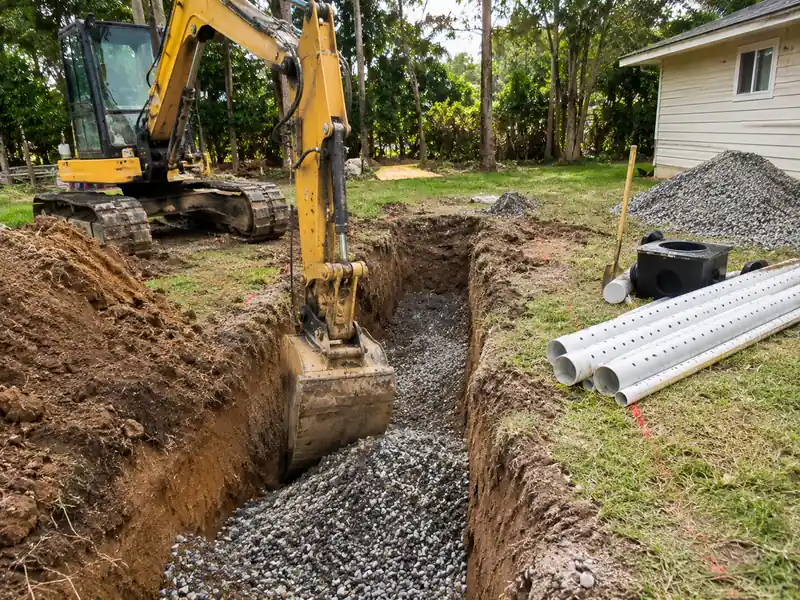
This is the excavation-heavy part of the job: removing or abandoning the old tank and field, digging for the new tank, distribution box and leach field, setting the components to the approved plan, and bringing in the fill specified in the design. Access matters here. Driveways, lawns, trees, fences and buried utilities all affect how equipment gets in and how the yard is restored afterward.
6. Inspection before backfill
A Board of Health agent inspects the installed system before it is covered. Nothing gets buried until the town signs off.
7. As-built plan and Certificate of Compliance
After backfill, the designer or installer submits an as-built drawing and sign-off paperwork, and the town issues a Certificate of Compliance. That certificate exempts the system from another Title 5 inspection for transfers within two years, or three years with pumping records.
What Drives the Cost of Septic System Replacement
Septic system replacement cost varies widely from one property to the next, which is why honest quotes come after the site has been tested and designed. These are the factors that move the number:
Factor | What keeps a job simpler | What makes a job bigger |
|---|---|---|
Soil and perc results | Sandy, well-draining soil | Dense till or slow perc rates that need a larger field |
Groundwater and ledge | Deep groundwater, no ledge | High seasonal groundwater or shallow ledge, often requiring a raised system and imported fill |
Lot size and setbacks | Room to place the field away from wells and wetlands | Tight lots, nearby wells or wetlands that limit placement |
Scope of failure | A component repair under a conditional pass | A failed leach field or cesspool that needs a full new system |
Access | Open, level path for equipment | Steep grades, trees, retaining walls or long distances from the driveway |
Restoration | Minimal lawn or driveway disturbance | Rebuilding driveways, walkways or landscaped areas after the work |
In most full replacements, the soil absorption system is the largest part of the job, because it carries the most excavation, material and design requirements.
Financial help in Massachusetts
There are several programs worth checking before you sign a contract. Massachusetts offers a state income tax credit for repairing or replacing a failed septic system or cesspool on a primary residence, claimed on Schedule SC. Many towns offer low-interest betterment loans through the Community Septic Management Program, and MassHousing runs a septic loan program through participating banks for homeowners whose systems failed Title 5. Current limits and eligibility are listed on MassDEP's financial assistance page.
Signs a Septic System May Be Failing
You do not have to wait for an inspection to know something is wrong. Call the Board of Health or a septic professional if you notice:
Sewage odors near the tank, the leach field or inside the house
Wet, spongy ground or standing water over the leach field when it has not rained
Grass over the field that is noticeably greener and faster-growing than the rest of the yard
Slow drains or gurgling plumbing throughout the house
Sewage backing up into the lowest drains or fixtures
Some of these overlap with ordinary yard drainage problems, which we cover in our guide to fixing water pooling in your yard. The difference is the source: septic problems usually come with odor and show up over the field itself.
Do You Have to Use the Inspector for the Repair?
No. MassDEP is clear that you are not required to hire the company that did your inspection to do the repair or replacement. You can get separate quotes from separate contractors. MassDEP also notes that no septic additive will make a failing system pass inspection.
What to Ask Before You Hire a Septic Contractor
Has the site already been tested and designed, or does the quote include coordinating that work?
Does the quote follow the approved plan exactly, including fill, components and the leach field layout?
How will equipment reach the work area, and what restoration is included afterward?
Who handles the Board of Health inspection before backfill and the as-built submission?
Is removal or abandonment of the old tank and field included?
What is the expected schedule once the permit is approved, and how is weather handled?
Will you get the scope, cost and payment terms in a written contract?
Frequently Asked Questions
How much does it cost to remove and replace a septic system?
It depends on soil and perc results, groundwater depth, ledge, lot size, setbacks and access. A full replacement with a new leach field costs considerably more than a component repair. Accurate pricing comes after the site is tested and the system is designed.
How often should a septic system be replaced?
There is no fixed schedule. A system lasts as long as its leach field keeps absorbing properly, which depends on soil, household water use and maintenance. MassDEP recommends pumping every three years, or every year if the home uses a garbage disposal, to help the system last.
How much does it cost to replace a septic tank?
Replacing only the tank is usually a smaller job than replacing the full system. In Massachusetts, a cracked or metal tank can be repaired or replaced under a conditional pass, without a new leach field design, as long as the soil absorption system is working.
What is the most expensive part of a septic system?
The soil absorption system, or leach field, is typically the largest part of the cost. It involves the most excavation and fill, and its size and design depend on soil and groundwater conditions at the site.
How long do I have to replace a failed septic system in Massachusetts?
Generally two years from the failed inspection, unless the Board of Health or MassDEP sets a different schedule. The Board of Health can require faster action if there is an imminent health hazard.
Planning a Septic System Replacement in Central Massachusetts
Groundscapes Inc. handles septic tank installation and septic system work along with the excavation and sitework a replacement depends on. We work in Spencer, Worcester, Leicester, Auburn, Millbury, Grafton, Shrewsbury and nearby towns across our service area.
If you are facing a septic system replacement after a failed Title 5, contact Groundscapes Inc. to talk through your site and your timeline.